Deep Encounters: LogBook
A year with a log
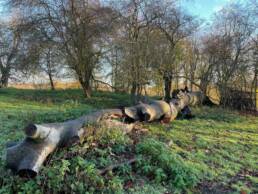
Drawn to a glimmer of water hidden in a small hollow of a log, I walked closer and looked inside. I’ve walked past this log many times, in a small hilltop woodland of the castle park grounds, but have never stopped to sit on it. I usually sit on a large tree stump at the bottom of the hill, nearer to the river and moat. Something pulled me closer this time, and I wanted to return. I took my lunch and sat on it, walked around it, peered into gaps, noted lichen marks, fungi and the aptly placed score lines around the centre of it.
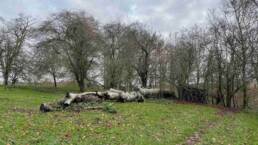
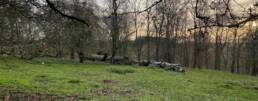
I mapped the rainwater puddle sheltered in a hollowed out section near the top of the trunk and will continue recording rainfall over the year: a miniature puddle world. Layered together, over time, their edges might have resonances with the tree rings at the base (a whole other world to discover). This patch of woodland is open enough to let in sun, rain and moonlight; their trace marks becoming part of the log. The cut-off branches add undulations to the long line of the trunk. With time, I’ll no doubt find sounds and movement in its solid stillness as new life grows on and from it. Walking slowly beside it, left foot heel touching right foot toe, the log (including tree stump and visible root base) is 84 lengths of my foot long, 6 footlengths high (highest part from ground), 4 wide at top and 14 wide at base. It has a metal id tag near its base, 00622.
‘Deep Encounters is a multifaceted mapping of a small piece of land involving artists working in different areas/location.
At its centre is the perception of a space in a much more intricate way than normal.’
(Janette Kerr, 2025)
Read more about the project and artists here. This is a Walking the Land project initiated by Janette Kerr. Participating artists: Zoë Ashbrook , Ruth Broadbent, Alison Berrett, Sara Dudman, Tamsin Grainger, Melinda Hunt, Richard Keating, Janette Kerr, Rachel McDonnell, Valerie Coffin Price, Amanda Steer, Sally Stenton, Molly Wagner.
I’ll be spending a year with this log, responding creatively to what I encounter and will add updates here as the project progresses.
LogBook (extracts)
January 2026
I have a collection of books on trees and nature and am starting to look back through some of them. In thinking about ‘deep mapping’ I want to find out more about the life within and from a log. Isabella Tree opens Wilding (Picador, 2018: p13) with a quote by Oliver Rackham from Woodlands, 2006: A “single 400-year-old-oak… [is] a whole ecosystem of such creatures for which ten thousand 200-year-old oaks are no use at all.” Tree writes of how, as they learnt more about the ways that “Dead and dying trees are part of nature’s recycling process, stimulating biodiversity”, they began to value them and decided to let Nature lead the way: “The oak took on a beauty all its own; a kind of sculptural, metaphysical grandeur… another universe sprang to life.”(p47).
I wonder how old this beech tree log in the woods is and how far its roots might still extend? When was it felled? What are its stories, past and present? What impact has this log in the woods had on its immediate environment? What will its impact be as time passes? Lots to discover in the coming months.
The rainwater pool / puddle continues to fascinate me, especially with some heavy rainfall recently. Over the last few months, I’ve been informally exchanging quotes with Valerie Coffin Price (Ffin), that we think might be of interest to each other – a lot of them are about water, from rivers to oceans. Serendipitously at the start of this month Ffin sent me the perfect quote for observing the rainwater collecting in a hollow of the trunk, from Antoni van Leeuwenhoek, 17thC ‘father of microbiology’: “When I feel disposed to look at all manner of little animals, I just take … the water out of stagnant shallow ditches: and in this I discover marvellous creatures.”
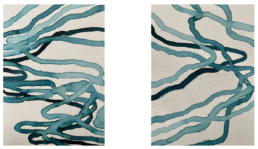
Having now made some tracings of the rainwater levels, I’ve been making some test pieces of how these might be presented – lots of possibilities and different media that I might use. Shown here are details from a couple of ink sketches, thinking through how to layer them together whilst also being able to tell each one apart.
As I get to know this beech log, I can’t help wondering what it was like when it was a tree. Did anyone climb it, like The Beanstalk on Hampstead Heath Cosmo Sheldrake describes when talking about how he records sounds of nature for his music? (in This Natural Life: Cosmo Sheldrake 14 Aug 2025, BBC Radio 4: 20.31 mins in)
He describes beech trees as octopus-like and great for climbing with their branches growing out then back into themselves: “All sense of scale disappears when you’re up there because you can’t see the ground anymore…”. Sheldrake uses recording equipment, such as hydrophones and geophones, to listen more deeply to the watery and earthy sounds. So far I’m only at surface level of what I can see, feel and hear.
How will this trunk, lying on its side, whether felled or through natural decay, nourish future generations of trees as well as other life? As I draw in my sketchbook, I’m thinking through drawing how this project might develop and what I might find on my next visit to the log. Using a side profile of the log, I’ve been drawing repetitive contour-like ‘tree ring’ lines, each one led by the one before, radiating outwards.
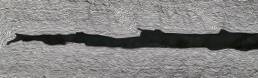
Whilst drawing in ink with my favourite glass dip pen, I listened to Suzanne Simard, Finding the Mother Tree (interviewed in Emergence Magazine, October 26, 2022). She speaks of the “wood-wide web” and her theory of how Mother Trees recognise their kin, nourishing their future growth. She talks of how trees can help to heal our separation from the living world. I looked at the outer ‘contour’ lines on each of my drawings and began to see the potential for a new forest growing from the ‘mother tree’, in this case the log, moving from lying horizontally on the ground, to upright.
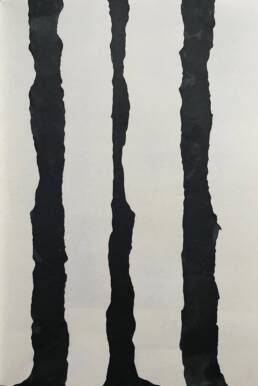
This month is unexpectedly full of quotes. I’ve added a few here as the process of rainy days in the studio drawing in my sketchbook has included immersing myself in podcasts and reading about trees. Over the coming months, I’ll have time to look closer and respond both on site and back in the studio. Ultimately this project is about spending time with the log, in the woods and responding to whatever comes up. I enjoy the research side to whatever I am working on, and a dialogue between making and discovery run alongside each other in varying degrees. The process generates ideas for meaning and making.
Within the context of selecting a site for this project, Deep Encounters, I thought I had chosen a small area to focus on but the more I look, the more I see. I started with the rainwater puddle as that is what drew me to this log in the first place and then started mapping the log. Not having an image from the air, and my gps apps having failed to record me walking around it, I’m using a side profile of the log (with the base out of sight, obscured by foliage) as a starting point for mapping the log and its environs.
December 2025
In trying to decide on which ‘small piece of land’ to choose for this project, this log was forefront in my mind. I thought about Greystones / Salmonsbury Camp as it would link to another project that I am working on but the site is larger. I wanted to be somewhere quiet without lots of people or traffic noise so I decided against an old oak tree (which has featured in a previous artwork, Abandoned Walks: Between Two Oaks, walking a line with Kel Portman), or the river, both in local parks. I also considered focusing on a puddle but that is more suited to other areas of my work (although a puddle is featuring in this project in another way).
I can’t fully articulate why I felt so drawn to this particular log; maybe it was the rainwater puddle within it, but it felt like it would work with my ways of making artwork as well as having the potential for trying out new ideas.* It seemed like a good starting point for sitting, looking, listening, watching, hearing, observing, slowing down and quiet contemplation, experimenting with ideas and responses. I find logs are great places to sit quietly, or catch up on work, plan ideas for teaching, catch up with friends… In 2023, Tamsin Grainger and I created a project, Conversations from a Log, an exchange of letters that became words, both spoken and written, walks and maps.
Although I have some initial ideas, I have no idea where it will end up. I’ll spend time with the log, finding miniature worlds, life and changes within it over the course of a year. Logs feel quite playful, especially in their association with childhood, climbing trees and clambering over them. Play and experimentation is my starting point.
Being part of a walking artists project, and with it being quite a long log, I decided to walk it and use the length of my feet as a measuring guide: 84 long x 4 wide (top end) x 14 wide (bottom end) x 6 high (is there a technical word for the length of my foot as a measurement – footlength?). I might also measure it in number of paces/strides for a smaller scale measurement.
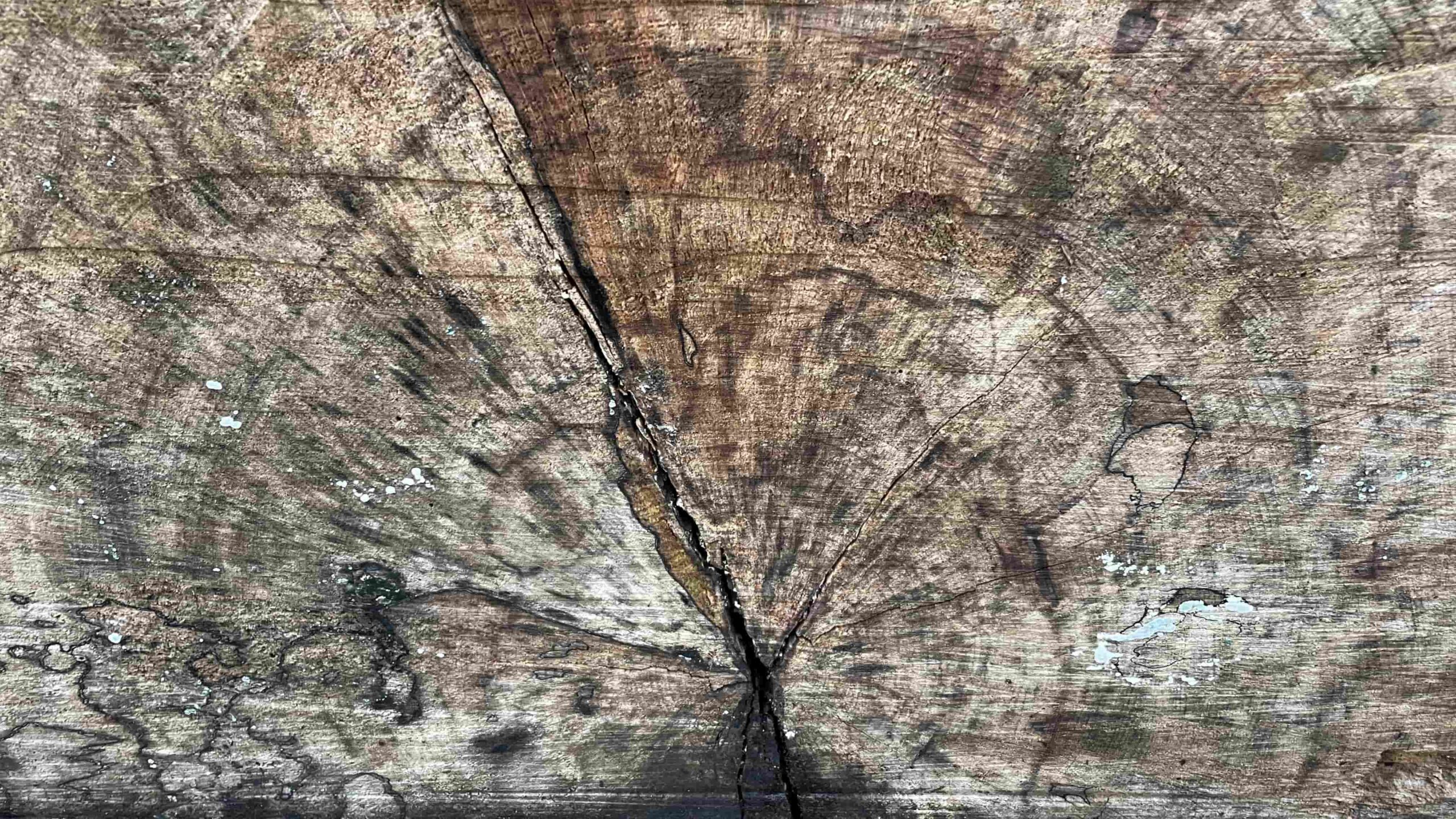
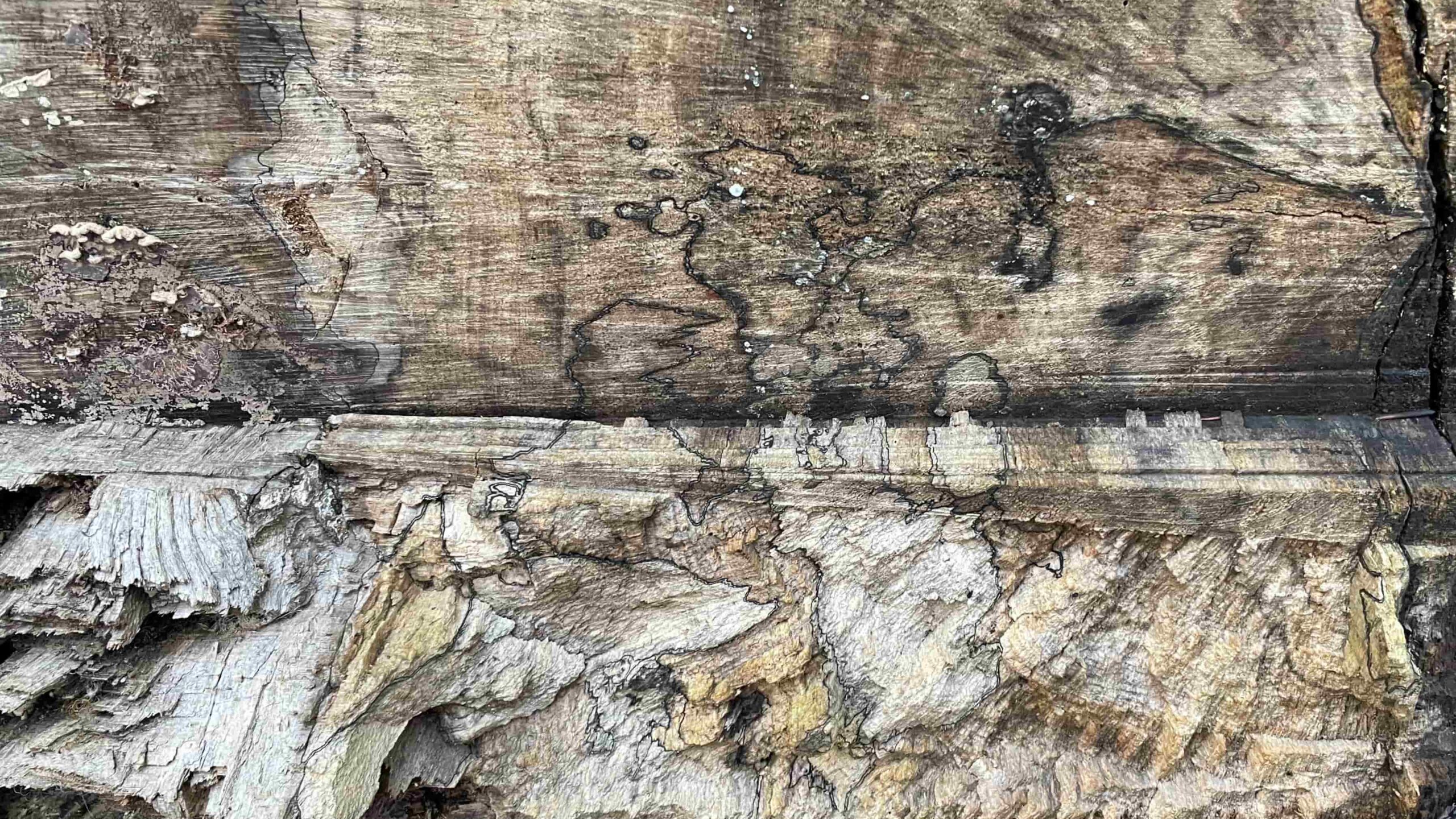
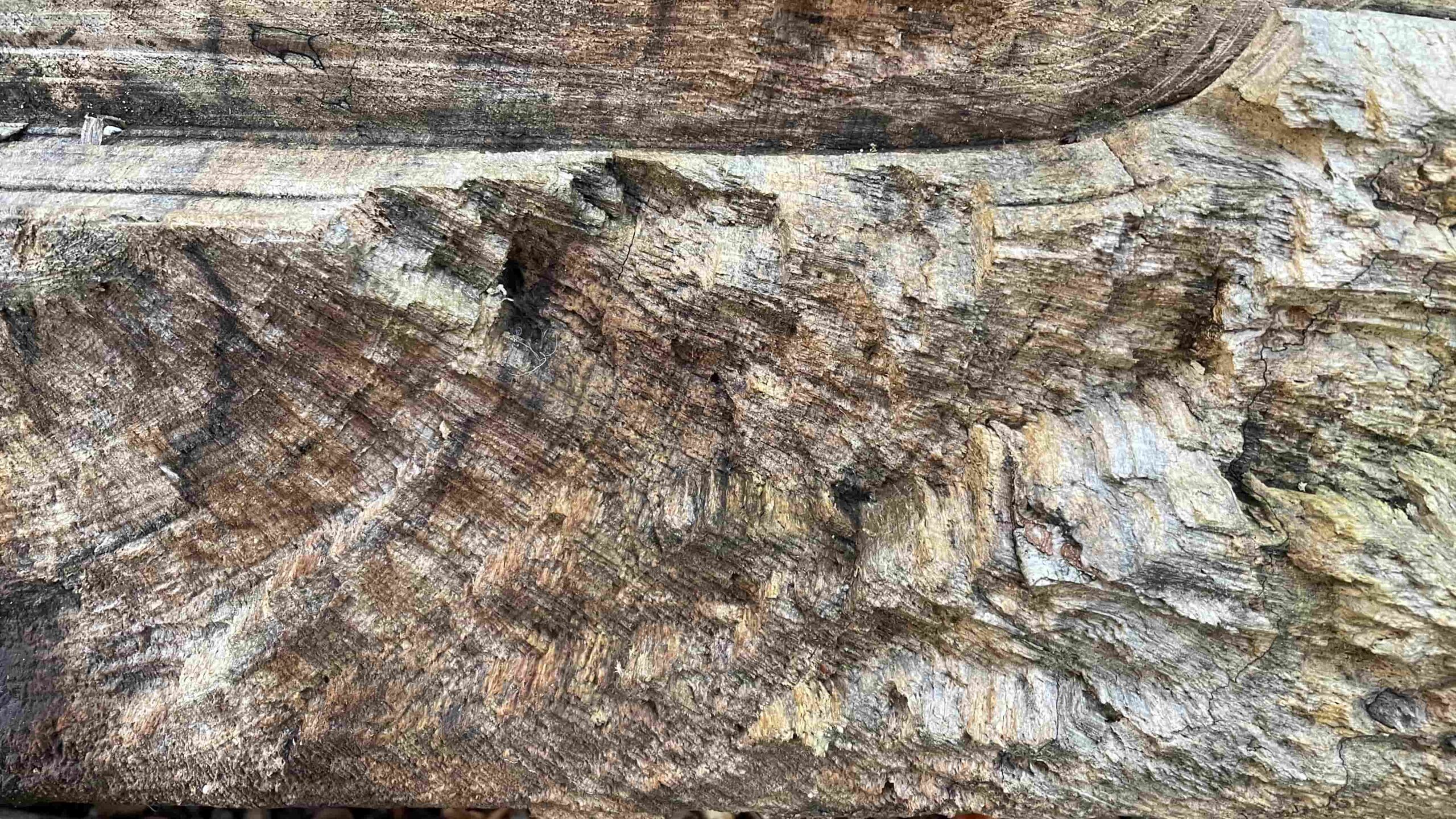
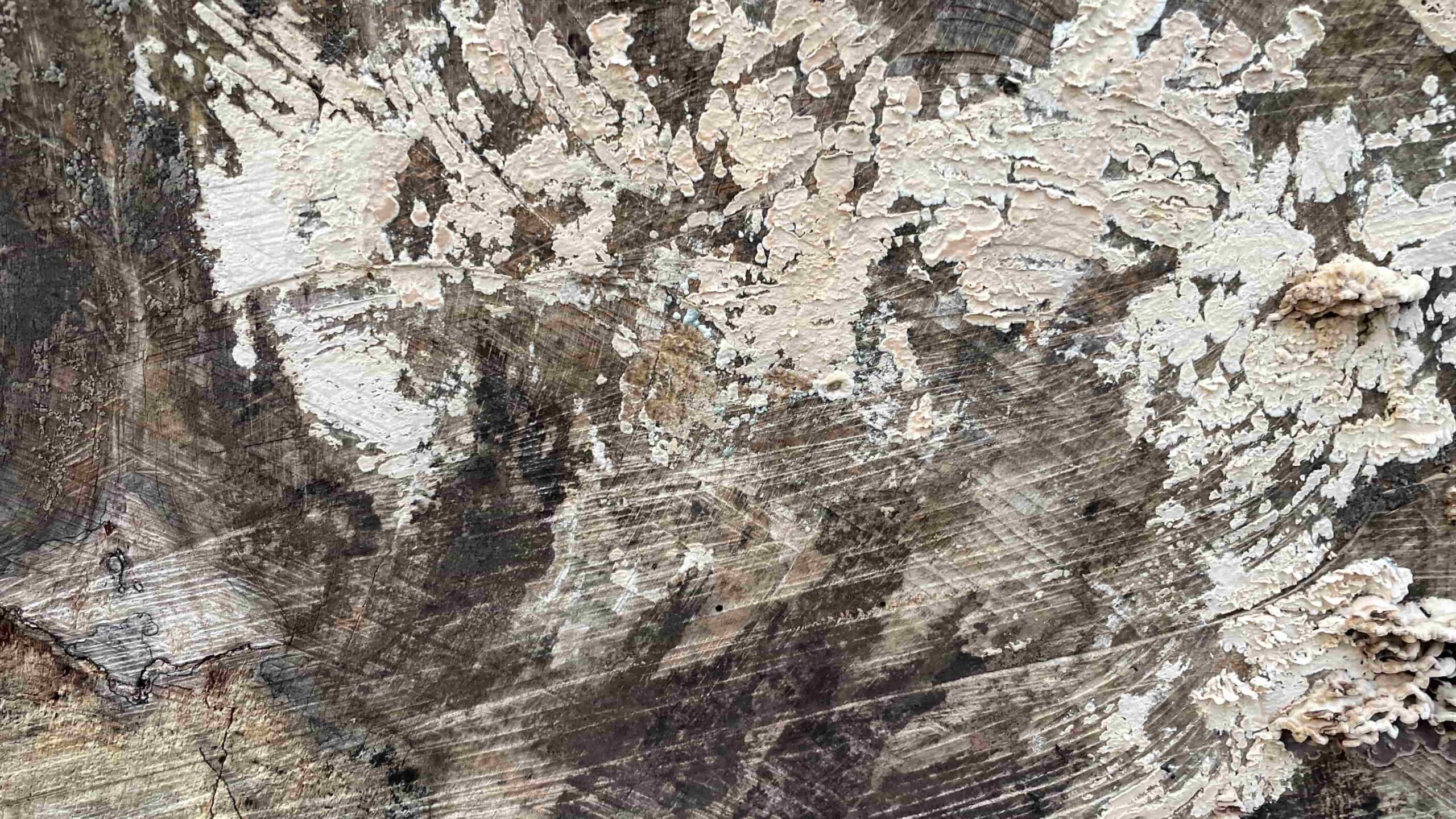
I’ve been wondering at what point does a fallen or felled tree become a log? Is this a log or a tree (trunk)? Its branches and top canopy have been cut off so it is just the trunk (not a fallen branch), with its base (stump) still in the ground. I’m assuming that the marks of it having been felled and no longer being an upright living tree, alongside being the trunk of the tree, is what makes it a log. This led me to contemplating the multiple meanings and their connections of the words log, logging, logged, logger, so I decided to call these diary extracts a LogBook.
Eating my picnic lunch on one visit, I noticed that the centre has lightly scored lines over its girth, an apt marker. There are lichens forming patterns of dots along the trunk, a variety of fungi, clumps of nettles, and a nearby den made from branches with a small solitary log inside it to sit on. My nature app identified the lines of the bark as an adder! It looks like a beech tree, from clues around it and from the way the rain marks the trunk. In the past I’ve made drawings of rain marks on beech trees, Rain-lines (beech), so am interested in spending more time observing how water and light land on it and move around it. There are other logs scattered nearby; this one has an id tag (00622) near its base and the initials TJ scored into it near the centre.
I’m making tracings of the outline edges of the puddle nestled in a hollow within the trunk, mapping the varying rainwater levels on each visit. I want to find an easier way to do this but it’s working for now. Maybe the edgelines of the puddle will find some resonances with the tree rings at the base, in shape and form, as well as being a temporal measurement, although the puddle ‘rings’, unlike the tree rings, will expand, contract, refresh, renew, and overlap. The puddle is a miniature world in itself, with its reflections, leaves at its base, and yet to be discovered life within it.
The watery elements to this log, from puddles and droplets of rain to rain-marks on the trunk are also part of the log and of this project. Visiting after heavy rain, the log looked different when wet. In winter, without leaves on the trees and hedgerow, the woodland opens up to views over surrounding countryside, so I can sit on the log and see the meander of the brook at the bottom of an adjacent field, in parts overflowing from the raised water levels. It’s a peaceful spot to be in and find my way into ‘deep mapping’; apart from occasional (dog) walkers, there are just the winter sounds of long-tailed tits and jackdaws.
* My time with this log will follow the principles of leave no trace. I will be mindful of the many ecosystems and living worlds, from plants to wildlife.
to be continued…
Subscribe to be added to my mailing list for occasional updates on exhibitions, events, new artwork and workshops.
I will treat your privacy and personal data with respect . Your details will only be used to send occasional newsletters if you click the link in the confirmation email and you can unsubscribe at any time by clicking on the link at the bottom of the newsletter or sending me an email at ruth@ruthbroadbent.com
Related Posts
Walking and Drawing: A Wobbly Line
After walking and drawing tracks and…

Drawing Water, from puddles to rivers and sea
Spending time by or in water seeps into…

As I walk I draw
As I walk I draw, As I draw I walk.…